
Powered By



When you hear someone mention alopecia areata, your first thought is likely related to hair loss. After all, alopecia areata is an autoimmune disease that causes patchy hair loss and can spread or progress to total hair loss. But this autoimmune condition isn’t just limited to your scalp; it can also affect your nails. In fact, 9 percent to 84 percent of people with alopecia areata also have nail changes.
These changes, which often include pitting or thin, brittle nails, can occur in people living with alopecia areata before they experience hair loss. Other times, a person mau begin to show changes in texture and appearance months or years after your alopecia areata diagnosis. Nail changes can even mirror the severity of your disease, with changes becoming more common in people with extensive or long-lasting alopecia.
Whether you’ve been diagnosed with alopecia areata or you’re only experiencing changes in your nails, it’s helpful to know what to expect. Here’s how alopecia areata affects your nails and how to tell the difference between alopecia nail changes and other conditions.
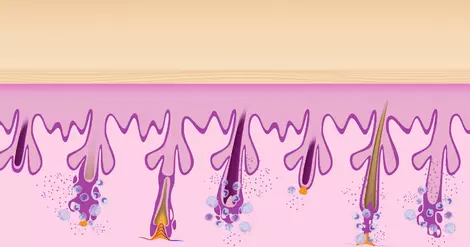
Alopecia areata is an autoimmune disease that attacks your body’s hair follicles, causing hair loss.
Because your hair follicles and nails have similar structures and are both made of a strong protein known as keratin, your immune system sometimes can’t differentiate between the two. This means that your immune system can attack both areas of your body. This then results in both patchy hair loss and changes in your nails, like pitting (or the appearance of tiny pits or dents on the nail, often in a geometric pattern) and brittleness.
While not everyone will experience nail changes with alopecia areata, some do. Nail abnormalities are especially common in people with more severe types of alopecia areata, like alopecia areata totalis or alopecia areata universalis.
If you experience nail abnormalities associated with alopecia areata, your symptoms may affect all of your nails or only a few. Your symptoms can also vary from nail to nail, with severe pitting in some nails and minimal pitting in others. Even the toenails can be impacted by alopecia areata.
Pitting is the most common nail change people experience, affecting about 12 percent to 53 percent of people with alopecia. Other common nail changes associated with alopecia areata include:
Most of the time, the nail changes you may experience won’t cause issues or scarring. But it could still be stressful or embarrassing, especially if you don’t like the way your nails look. Fortunately, nail changes sometimes spontaneously resolve on their own or show improvement with some medications and treatments used for alopecia areata.
Recognizing how alopecia areata can affect your nails is an important part of effectively addressing and managing your condition. But the nail-related symptoms of the condition — like pitting or brittle nails — can often overlap with other nail disorders like those seen in psoriasis, nail fungus, lupus, and rheumatoid arthritis. A dermatologist can evaluate the appearance of your nails and discuss any of your other symptoms when making a diagnosis.
Although rare, in some cases, your dermatologist may also need to perform a biopsy of your nail matrix to confirm a diagnosis, especially if you haven’t experienced any hair loss. A biopsy involves taking a sample for examination under a microscope. This helps them differentiate alopecia areata from other conditions that cause nail changes. But try not to self-diagnose or assume you know what’s causing your nail changes.
Sometimes alopecia areata can occur alongside other conditions that may be causing your nail changes, like thyroid disease or atopic dermatitis (the most common form of eczema). For instance, people with eczema may also have Beau’s lines (deep grooves or gaps), nail pitting, and trachyonychia. And people with thyroid disease might experience nail brittleness, koilonychia (spoon-shaped nails), and clubbing.
Many nail changes, like dry or brittle nails, might be harmless or a result of your environment or habits. However, other nail symptoms could be a sign of an underlying health condition like alopecia areata, psoriasis, atopic dermatitis, fungal infection, or lung disease.
That’s why any changes to the texture, appearance, or color of your nails should be evaluated by a dermatologist. Not only can they diagnose your condition, but they can also provide treatment options and help alleviate pain or other uncomfortable symptoms.
Here are some nail changes or symptoms that should prompt a visit to the dermatologist:
Overall, any change in your nails that’s new, worsening, or unfamiliar should be mentioned to a healthcare provider, preferably a dermatologist. These physicians are experts in addressing issues with your hair, skin, and nails, including alopecia areata. Tracking patterns in the timing of your nail changes — for example, if they appeared before, during, or after hair loss — can also be helpful for your provider.
On MyAlopeciaTeam, people share their experience with alopecia, get advice, and find support from others who understand.
If you have experienced nail changes with alopecia areata, what did you do to treat your symptoms? Let others know in the comments below.
Get updates directly to your inbox.




 Continue with Facebook
Continue with Email
Continue with Facebook
Continue with Email
Continue with Facebook
Continue with Email
Continue with Facebook
Continue with Email
Become a member to get even more





 Join
Join

 Your Privacy Choices

This is a member-feature!
Sign up for free to view article comments.
Didn't know that I have scarring alopecia everything I tried don't work doctor did tell me won't grow Back i just need to get the strength to cut it all off haven't got the will power net
We'd love to hear from you! Please share your name and email to post and read comments.
You'll also get the latest articles directly to your inbox.